


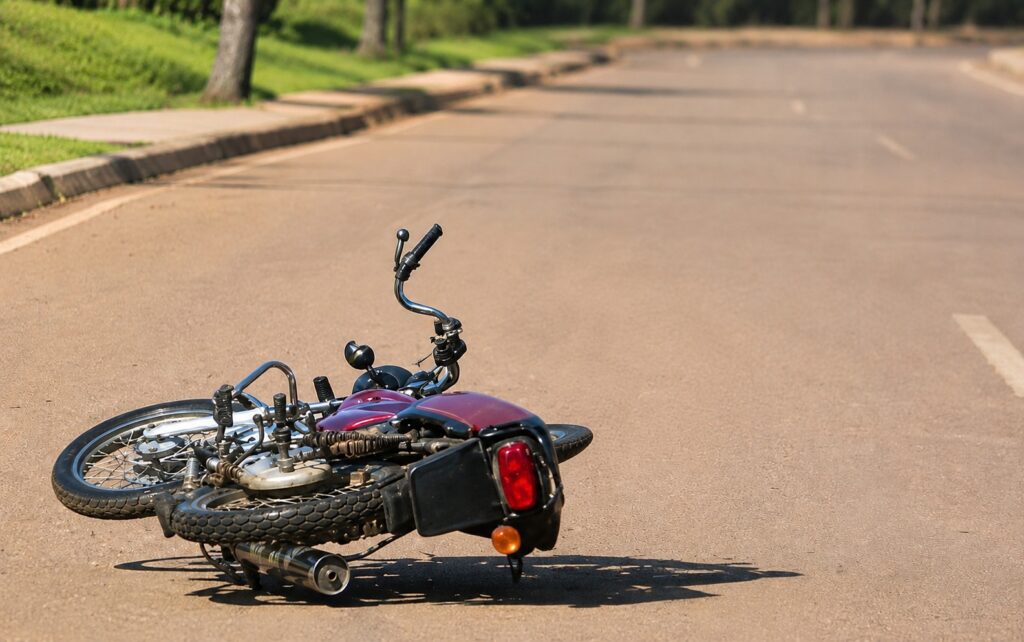
A boda boda accident can happen in seconds, but what you do afterward can affect your health and any compensation claim that follows. If you are a passenger, pedestrian, cyclist, rider or another road user, focus first on safety, medical treatment, police reporting and preserving evidence.
1. Get to Safety and Seek Emergency Help
Your first priority is to protect yourself and others from further harm. If you can move safely, get away from moving traffic and ask bystanders to warn approaching vehicles. Do not put yourself at greater risk while trying to photograph the scene or help another person.
The National Police Service lists 999, 112 and 911 as police emergency numbers. Its service standards also include attending to traffic accidents and incidents as an immediate service. An early call can therefore help bring police assistance to the scene.
If someone has a serious injury, avoid moving them unless leaving them in place creates an immediate danger. Seek medical assistance and follow trained responders’ instructions.
2. Get Medical Treatment Even If the Injury Seems Minor
You should get medical attention after an accident, even when an injury initially appears minor. Some injuries are not obvious immediately, and an early examination creates a record of your condition after the crash.
Keep treatment notes, medical reports, prescriptions, diagnostic results and receipts. These documents can help establish the injuries suffered and the medical expenses caused by the accident.
Medical evidence becomes especially important when an injury affects your ability to work or requires continuing treatment. A medical report can help show the extent of the injury and whether further treatment, rehabilitation or lasting disability is involved. A receipt alone does not guarantee recovery of an expense. The expense must be relevant and properly proved.
3. Report the Accident to the Police
An injury-causing road accident should be reported to the police. Section 73 of the Traffic Act requires a driver involved in an accident causing injury or damage to stop and provide particulars when required. Where injury has occurred, the driver must report the accident to a police station or police officer as soon as reasonably possible and, in any event, within 24 hours.
If you are an injured passenger or another road user, make sure the accident is brought to the police’s attention, especially if the rider leaves the scene or fails to report it.
The National Police Service Standing Orders provide for recording accident reports in the Occurrence Book, identifying parties and witnesses, recording information about injured people, examining relevant vehicles and taking photographs where possible. These records can help document the accident, but a police record does not by itself prove that another person was legally negligent.
4. Ask About the Police Abstract and P3 Form
The police abstract is an important accident record, but an injured person should also ask about the P3 form. The National Police Service Standing Orders provide for an injured person whose name is recorded in the Occurrence Book to be issued with a P3 form after recording a statement, subject to the procedure in the Standing Orders.
Where an injured person’s name was not initially recorded, the Standing Orders provide for treatment documents to be supplied to the investigating officer as proof of involvement, after which the complaint can be recorded and the P3 issued according to the prescribed procedure.
Keep copies of the police abstract and P3 form. They can support a later personal injury claim, but neither document alone establishes negligence or determines how much compensation is payable.
5. Preserve Evidence at the Accident Scene
If your condition allows it, take photographs of the motorcycle, other vehicles, visible damage, road markings, road position and the surrounding area. You can ask a trusted person to do this if you are injured.
Write down what you remember as soon as possible. Record the approximate time and location, direction of travel, what happened immediately before the collision and anything you observed about the rider’s driving.
This evidence matters because accident scenes change quickly. Vehicles are moved, debris is cleared and witnesses leave. The police Standing Orders recognise photographs, witness information and vehicle examinations as part of accident investigations.
6. Record Witness Details
Get the names and telephone numbers of people who witnessed the accident, where possible. Independent witnesses can be important if the rider, passenger or another driver later gives a different account.
A witness may have seen the motorcycle speeding, overtaking, losing control or colliding with another vehicle. That evidence can help determine whether negligence occurred.
Do not coach witnesses or ask them to change their account. Record their genuine details and pass them to the police or your advocate. The Standing Orders require accident investigators to obtain witness particulars with as little delay as possible.
7. Record the Motorcycle, Rider, Owner and Insurance Details
If it is safe, record the motorcycle registration number and the rider’s details. Find out who owns the motorcycle and which insurer provides its third-party cover.
The National Transport and Safety Authority (Operation of Motorcycles) Regulations require motorcycle owners to provide prescribed protective gear. They also require private motorcycles to have third-party insurance and motorcycle taxis to have third-party public service vehicle insurance.
Insurance information can be important when a third-party injury claim is pursued. However, insurance does not automatically establish liability or guarantee payment. The claimant still needs to establish a valid legal claim and prove the relevant loss.
8. Be Careful About Settling at the Accident Scene
A rider or owner may offer to pay a hospital bill or give you cash immediately after an accident. Think carefully before treating that payment as a final settlement.
An injury may later require additional treatment, rehabilitation or time away from work. An immediate payment may not reflect those losses.
Keep a record of any money received. Do not sign a document releasing your claim unless you understand what it means. For a serious injury, legal advice before accepting a final settlement can help you assess whether the proposed payment properly reflects the evidence.
9. Keep Proof of Medical and Financial Losses
Create a file for everything connected to the accident. Keep hospital bills, pharmacy receipts, treatment records and reasonable transport expenses related to medical care. If you miss work, keep evidence of your employment or income and the period affected by the injury.
Different damages require different proof. Special damages, such as particular expenses, should be specifically pleaded and proved. Claims involving lost income or reduced earning capacity may require employment, income and medical evidence.
Keep original documents safe and make copies or digital scans.
10. Act Before the Limitation Period Expires
Do not postpone getting legal advice about a potential claim. Section 4(2) of the Limitation of Actions Act provides that an action founded on tort generally cannot be brought after three years from the date the cause of action accrued.
Section 27 provides a limited route for extending time in certain personal-injury cases where material facts relating to the cause of action were outside the claimant’s knowledge and the statutory conditions are met. Court leave is required. An extension is not automatic.
The safer approach is to have the claim assessed early. Waiting for informal negotiations with a rider or insurer can create a limitation problem if court proceedings later become necessary.
What You Should Keep After the Accident
Try to keep:
- Medical records and receipts.
- Police abstract.
- P3 form, where issued.
- Motorcycle registration details.
- Rider, owner and insurance details.
- Witness names and contacts.
- Photographs or other scene evidence.
- Evidence of income or other financial losses.
Conclusion
After a boda boda accident, deal with safety and medical care first. Then protect the evidence that may be needed later. Report the accident to the police, ask about the police abstract and P3 form, record witnesses and preserve photographs and medical documents.
Do not assume that a police abstract proves negligence or that motorcycle insurance automatically guarantees compensation. A personal injury claim depends on the facts, evidence of responsibility and proof of the losses suffered.
If the injuries are serious or responsibility is disputed, consult a qualified Kenyan advocate early. Prompt action can help preserve evidence and protect a claim within the applicable legal time limit.
Legal information only. This article is for general information and is not a substitute for advice from a qualified advocate who has reviewed the facts of a particular accident.
